 Ask AI
Cloudinary Image & Video release notes: July 9, 2026
Last updated: Jul-09-2026
We publish Cloudinary Image and Video API release notes periodically to give you a quick overview of all the new features, enhancements, and fixes that we've recently released for Cloudinary developers. When relevant, they may also give sneak previews of upcoming features and/or other share important announcements.
Cloudinary Image
Generate images from natural language with Image Generation
The new Cloudinary Image Generation add-on lets you generate images from natural language text prompts using a unified API that supports multiple AI model families. Choose from photorealistic, illustrative, campaign-focused, and text-rendering models to suit your use case.
Generated images are automatically stored in your Cloudinary product environment as native assets so that you can manage them just like any other asset: apply tags, add metadata, and include them in workflows. Then deliver, transform, and optimize them on the fly.
Example: Generate a campaign image and serve it across multiple channels
This request generates a high-resolution product image and stores it permanently in your product environment. Once generated, you can serve any crop or format using Cloudinary's dynamic URL transformations, with no re-generation needed.
Serve any crop on the fly from the same generated source image by applying standard transformations. For example:
-
Instagram (1:1)
-
TikTok (9:16):
-
Web banner (16:9):



New Console Studio UI for image transformations
The new Console Studio is now available on all plans.
Studio provides a visual workspace for building and previewing image transformations, refining AI-generated edits, and creating reusable named transformation templates. You can apply transformations to one or multiple images, save the results as new assets or overwrite existing assets, and create or refine edits as needed.
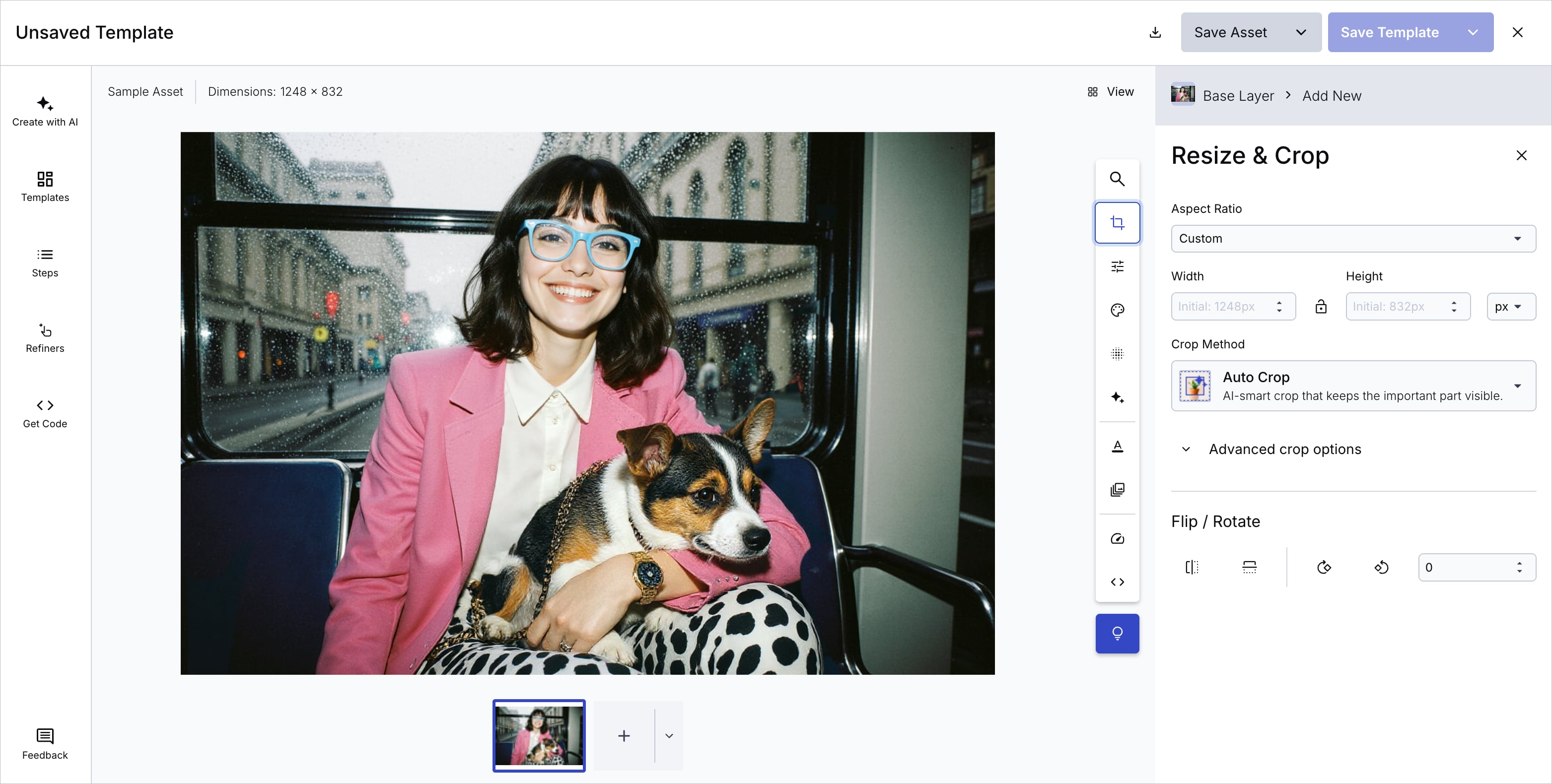
Learn more: Studio overview | Creating named transformations with Studio
Dynamic download filenames using variables
The fl_attachment flag now accepts a user-defined variable as the filename value, so you can name downloaded files dynamically based on each asset's metadata. Assign the variable a value from the asset's structured metadata (md:!<external_id>!) or contextual metadata (ctx:!<key_name>!) in an earlier transformation component, then reference it as the attachment filename.
Example: Name the downloaded file based on the asset's contextual metadata
The $n variable takes the value of the image's productType contextual metadata key, which is shoes, so clicking the URL link downloads the file as shoes.jpg:
Our image optimization technology is now patented!
We're proud to announce that Cloudinary has been granted U.S. Patent No. 12,602,838 for the image optimization technology behind the latest generation of q_auto. This milestone recognizes the innovation that lets Cloudinary intelligently balance visual quality and file size for every image, and cements our leadership in media optimization.
If you aren't already applying q_auto (or better yet, f_auto/q_auto) to every asset you deliver to get the best format and quality optimizations, no time like the present!
Learn more about automatic quality (q_auto)
Cloudinary Video
Custom fonts for video subtitles
The l_subtitles transformation now accepts custom fonts in addition to universally available font names. You can brand subtitles with .ttf, .otf, or .woff2 font files uploaded to your product environment as raw, authenticated assets.
Example: Embed subtitles using the custom Alex Brush.ttf font at size 40, in white text on a black background
Agentic skills and IDE tooling
New Cloudinary skill for Next.js
Building with Cloudinary in a Next.js app? Our new cloudinary-next skill helps your AI agent get it right the first time. It encodes Cloudinary's recommended Next.js patterns, so the code your agent generates follows best practices and patterns from the start, using Cloudinary Next.js SDK components and helpers like CldImage, CldVideoPlayer, and CldUploadWidget.
The result is correctly configured, reliable Next.js integrations, with clean Server and Client Component boundaries, server-side uploads and deletes, signed uploads, responsive images, overlays, OG social images, and more.
Just run the npx command below to install:
Learn more about Cloudinary agentic skills
Get the latest updates on all skills
We've recently leveled up our existing cloudinary-docs, cloudinary-transformations, and cloudinary-react skills. Guided by research and automated testing against real customer use cases, we refined each one to improve its performance and the quality of the results it produces.
If you've already installed any of these skills, we recommend that you re-run the npx command to pick up the latest improvements:
SKILL.md file includes a version value in its metadata. To check whether you're on the latest at any time, compare the versions of your installed skills against those in the Cloudinary Skills repo.Learn more about Cloudinary agentic skills
Cloudinary VS Code Extension 1.0 is here
The Cloudinary VS Code Extension is now GA, with a batch of new capabilities shaped by Beta feedback.
Manage your assets and wire up Cloudinary's AI tooling without leaving your editor, in VS Code or any VS Code-based IDE (Cursor, Antigravity, Windsurf, and more).
What's new in 1.0:
- Docs AI assistant: Ask questions about Cloudinary right in your editor and get answers drawn from the docs, with source citations and conversation history.
- Home dashboard: A redesigned central panel with quick actions, Media Library search, the Docs AI assistant, and AI tool configuration.
- Configure AI tools: Set up Cloudinary agent skills and MCP servers for your AI coding assistant in one step, at project or global scope.
- Rebuilt media library: A faster asset explorer with progressive loading, search, filtering, and sorting.
Watch it in action:
Install the extension from the Extensions tab of your IDE or from the marketplace:
- VS Code Marketplace
- Open VSX Registry for VS Code-based IDEs such as Cursor, Antigravity, etc.
Asset management and upload
Updated backup experience in Console Settings
The Backup page in the Console Settings lets you enable automatic backup and configure where your backups are stored. You can now also back up existing assets without leaving the page.
Every job run in your product environment now appears in the Previous backup jobs for existing assets table, where you can check its process ID, creation timestamp, and current status to confirm it completed successfully and keep a record of when backups were run.

Account management
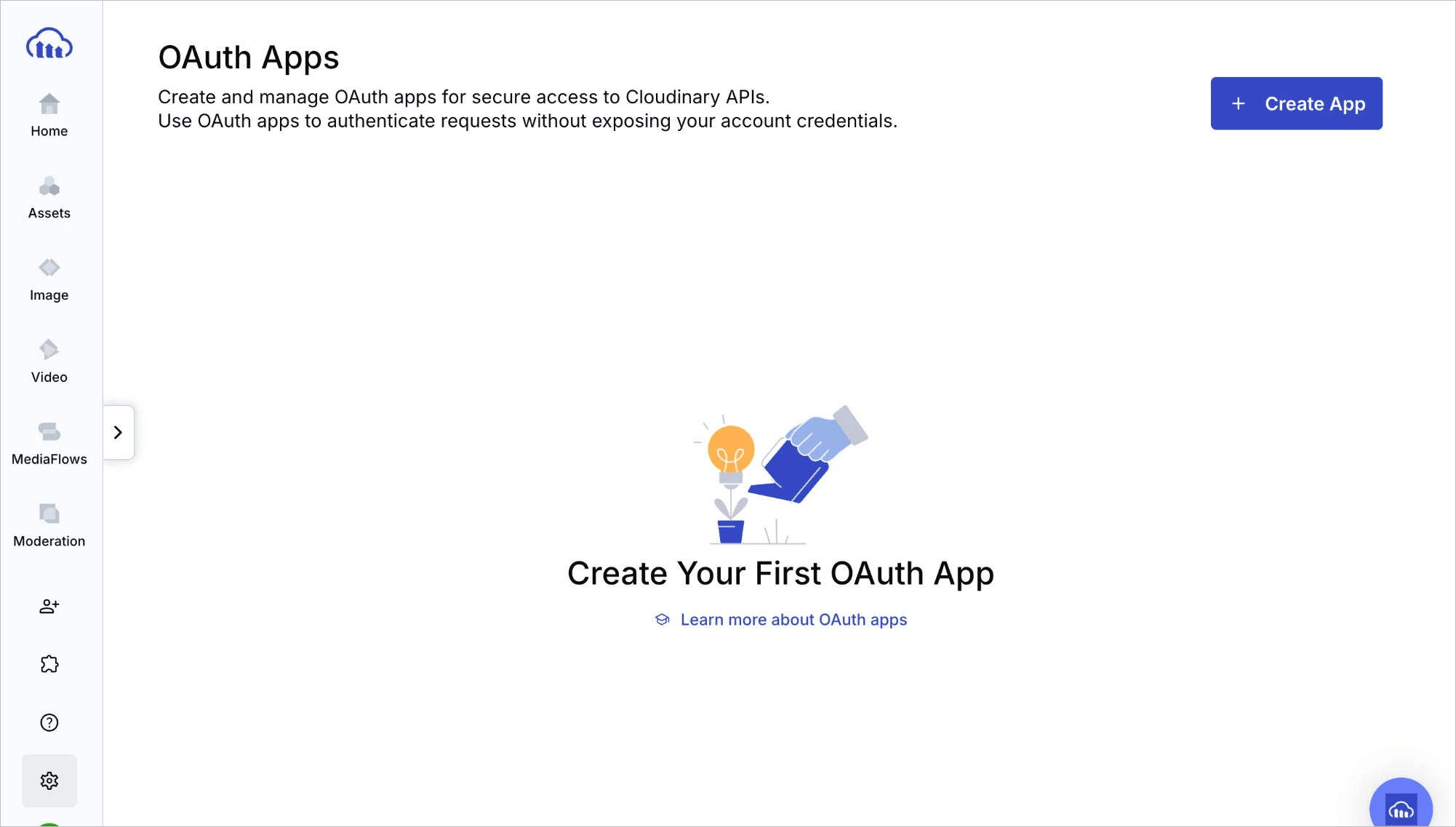
Create and manage OAuth apps yourself in the Console
Setting up OAuth 2.0 access to Cloudinary's APIs no longer requires a support ticket. You can now create and manage your own OAuth apps directly in the Console, under Settings > Developers > OAuth Apps.
Create an app, generate a client secret (and rotate it whenever you need to), select the scopes your app needs, and add the redirect URIs for your integration. Deleting an app revokes its access, with no need to involve Cloudinary support.
Account creation API for agents
AI agents can now create a Cloudinary account programmatically with the new account creation API for agents. The agent sends a single request and receives the account details and credentials, which work after a human verifies the email to activate the account. This API is in Early Access.
Example: Create an account with a single request
The response includes the new account details, one product_environments entry with the cloud name and API credentials, and a guidance block the agent can use to walk the user through email verification and SDK setup.
Docs and demo apps
Download transcript button for video tutorials
Documentation pages with video tutorials now include a Download Transcript button below the video player. Select it to download the video transcript as a VTT file, which you can use with screen readers, translation tools, or any VTT-compatible application.
Check out all the Image & Video API video tutorials
Announcements
Cloudinary Moderation now includes Video Moderation!
Video Moderation extends Cloudinary Moderation beyond images, helping teams automate video review at scale while reducing manual effort.
Every video that enters your pipeline, from marketplace sellers, agency partners, creators, or end users, can be evaluated in near-real time against your brand, safety, and compliance rules, then automatically approved, routed for human review, or rejected.
What's included?
- Content detection: detect selected objects, scenes, or concepts across video frames
- Video text analysis: moderate on-screen text in videos
- Video transcript analysis: moderate spoken content using generated transcripts
- Metadata validation: verify that on-screen text matches metadata values, for example, confirming that the correct product appears in the video
Register for notifications
Make sure you always know when we publish new release notes with the Image and Video release notes RSS feed:
 Grab this RSS link to watch for new Image and Video release notes in your favorite RSS reader.
Error
Rate this page:
