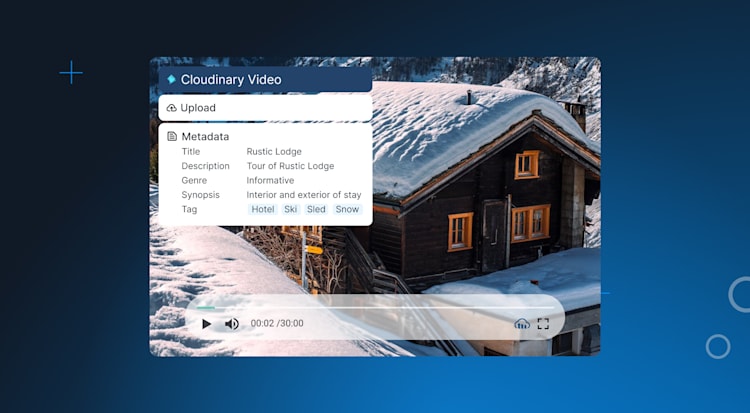
Video without metadata is like a product without packaging. Without it, you don’t know what the product is, how to use it, or why it’s important. Now imagine that problem multiplied across thousands, or even millions, of assets.
For businesses that manage vast asset libraries and use video to communicate with their customers, metadata is what holds the entire content management and end-user experience together. It’s the key to organizing content, understanding each asset, and shaping the kind of targeted and engaging experiences that modern audiences expect.
But to unlock its full value, it’s important to understand what metadata is, how it works, and why it matters to both businesses and customers.
Video metadata isn’t a single data point. It’s a collection of information that describes a video from multiple angles. Most of it falls into three main categories:
- Descriptive metadata. This is information about the content like title, description, genre, synopsis, and tags.
- Technical metadata. This is more technical information, like duration, file format, resolution, and framerate.
- Structural metadata. This is information about how the video is organized. For example, chapters, scenes, and time-based segments.
These categories cover the basics, but many organizations also rely on additional layers of metadata, such as rights and licensing details or behavioral signals like views, likes, and engagement patterns.
Metadata isn’t just extra information. It’s a strategic asset with direct business impact:
Without metadata, teams waste time hunting for the “right” videos. With it, organizations can instantly search and filter by creator, usage rights, visual elements, or any other defined attribute.
Metadata keeps growing libraries manageable. It powers intelligent tagging, automated categorization, and clean workflows that avoid duplication and inconsistent naming.
Search engines and the LLMs used by AI answer engines rely heavily on metadata to understand video content. Rich metadata like titles, tags, captions, and alt text can significantly improve indexing and ranking.
The better a platform understands your video content, the more accurately it can tailor recommendations, target ads, or customize user experiences.
Teams with metadata can automate repetitive tasks, streamline review/approval, and reduce reliance on manual processes.
Today’s viewers have been conditioned by popular platforms like Netflix and YouTube to expect rich, seamless video experiences. Metadata makes those experiences possible. With accurate descriptive metadata, businesses can provide:
- Clear titles and descriptions overlaid directly in the video player.
- Chapters or timestamps that let viewers quickly jump to the moments they care about.
- Subtitles and captions in multiple languages for accessibility and inclusivity.
When video lacks metadata, audiences feel the difference immediately. Navigation becomes harder, accessibility drops, and engagement suffers.
So if metadata is essential to both businesses and viewers, how do you go about scaling it efficiently? Organizations tend to rely on one of three methods:
This is common in the entertainment world, where companies can purchase professionally curated metadata for movies and TV shows. But because these services only cover widely distributed commercial content, they offer little value for businesses producing their own marketing, product, or internal videos.
Humans watch the content and craft titles, descriptions, chapters, and tags. It’s accurate but slow and expensive. It’s an approach that works for premium entertainment, but not for the fast-moving, high-volume world of enterprise video.
AI tools can instantly analyze videos and generate metadata automatically, either during upload or across an existing library. This method is scalable, cost-effective, and increasingly accurate, making it the most practical solution for businesses of all sizes.
Cloudinary Video leverages proprietary AI to automate the creation of essential descriptive and structural metadata. Everything from titles and descriptions to tags, chapters, and subtitles can be created without manual intervention. The result is a scalable, cost-efficient approach that unlocks better organization, richer experiences, and faster workflows.
Cloudinary supports several metadata-generation workflows, allowing teams to choose the method that best fits their requirements:
- On upload. Automatically generate metadata as videos are added to your account. By embedding this step into upload presets, you ensure every new asset is compliant with your metadata standards moving forward.
- In batches across your library. Use Cloudinary to generate metadata for existing assets, either for your entire library or a curated segment. This is ideal for refreshing older content, though larger archives may benefit more from on-demand generation.
- On demand during playback. Generate subtitles, chapters, titles, and descriptions only when a viewer presses play. This just-in-time method is highly efficient and avoids processing assets that may never be viewed (note that tags are not generated using this method).
Together, these options give every team a flexible, scalable way to keep their video metadata complete and up to date.
Metadata is the backbone of modern video, shaping how videos are discovered, understood, and experienced. As companies produce more content and audiences expect more from it, the ability to generate and manage metadata at scale becomes a real competitive edge.
Cloudinary Video brings automation and efficiency to that challenge, turning what was once a manual bottleneck into an integrated part of your workflow. With AI-powered metadata generation, your video library becomes smarter, more organized, and more valuable with every upload.
Looking to elevate your video strategy? Cloudinary Video can help you create experiences worthy of today’s viewers. Contact us for a personalized demo today.