
When people hear “Cloudinary,” they often think of fast, optimized image and video delivery. However, in modern enterprise architectures, Cloudinary plays a much bigger role: It is the media backbone that connects product information management (PIM), content management systems (CMS), commerce engines, and workflow platforms.
Enterprises need a clear, consistent way to visualize how Cloudinary fits into their composable stack. It shows how it connects systems, governs assets, and scales across environments. That’s where the Cloudinary Architecture Blueprint comes in.
At its core, Cloudinary provides a single source of truth for digital assets. It ensures consistency across multiple downstream systems and touchpoints, whether those assets are destined for an e-commerce storefront, a CMS-driven experience, a creative workflow, or a media-centric orchestration engine like Cloudinary MediaFlows.
- Metadata-first approach. Structured metadata ensures that assets remain discoverable and reusable.
- Governance. Permissions and folder structures safeguard access across teams.
- Composable by design. Cloudinary’s APIs and connectors enable flexible integration with best-of-breed systems.
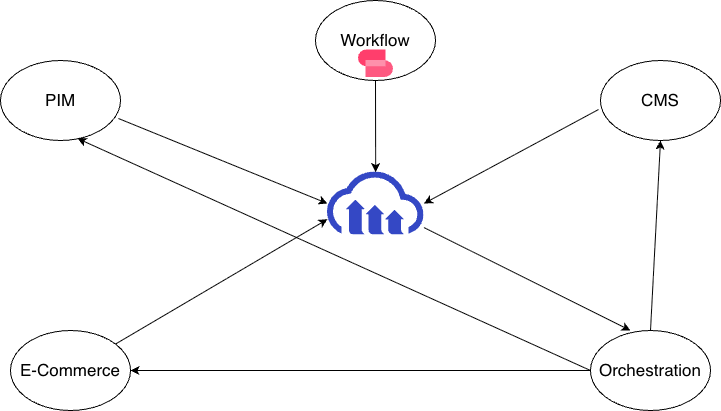
The diagram below illustrates a generic composable ecosystem:
- PIM supplies product information.
- CMS manages content experiences.
- Commerce engines drive transactions.
- Creative tools manage production.
- Orchestration platforms (like MediaFlows, iPaaS, or integration layers) connect the dots.
- Cloudinary sits at the center of your media workflows, acting as the media backbone.
This pattern repeats across industries: fashion, travel, retail, entertainment, and more. Cloudinary provides a stable, media-centric foundation while allowing enterprises to swap or upgrade adjacent systems.
The diagram below shows Cloudinary at the center of this ecosystem, ensuring that content, product data, and creative assets flow seamlessly between systems.
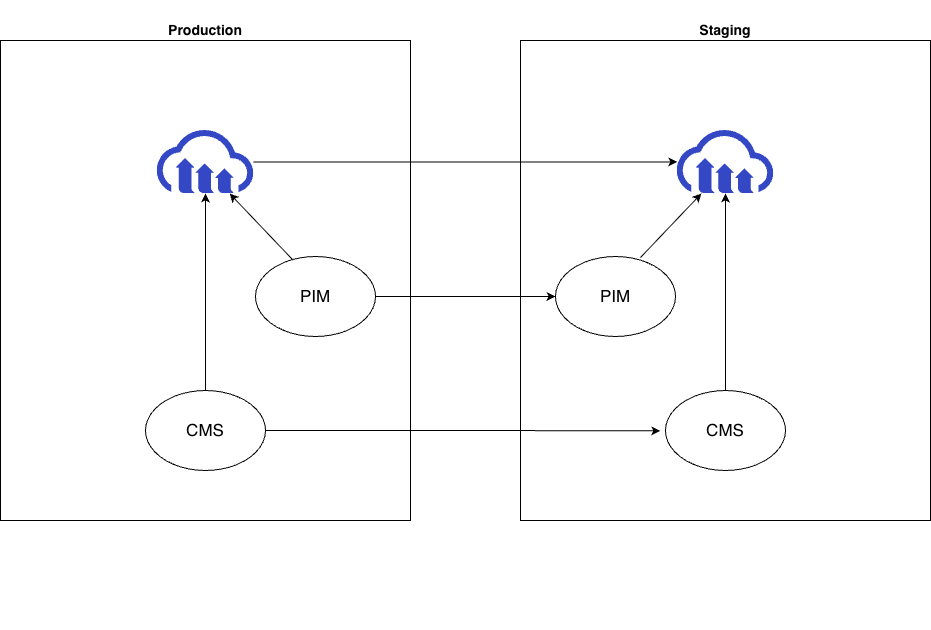
Enterprises often run into governance challenges when balancing innovation in staging with reliability in production. Cloudinary supports this by keeping environments clean and allowing controlled data synchronization.
- Stage systems are where teams experiment, model schemas, or test workflows.
- Production systems hold the canonical truth for live customer experiences.
- Synchronization flows ensure assets and metadata are safely promoted without polluting environments.
This model is crucial in e-commerce, where catalog updates, product imagery, and campaign assets need careful coordination across environments.
In the context of composable commerce and MACH architectures (Microservices, API-first, Cloud-native, Headless), Cloudinary operates as a Media PBC because it:
- Easily integrates with PIMs, CMSs, commerce engines, and search systems.
- Offers out-of-the-box transformations, AI tagging, and metadata enrichment.
- Works with other PBCs like checkout, payments, and search.
Cloudinary’s APIs and UI widgets provide the connective tissue between systems. The APIs enable automation and orchestration across platforms, while widgets empower teams to manage and use media directly within their existing tools. This allows Cloudinary to operate as a media hub and scale into ecosystem orchestration, reducing friction in the creative-to-commerce pipeline.
The power of this architecture becomes clear in real-world workflows such as agency-driven media production. One of the most common enterprise use cases for the Cloudinary Architecture Blueprint is managing high-velocity media production pipelines, from external agency photoshoots to personalized end-user delivery.
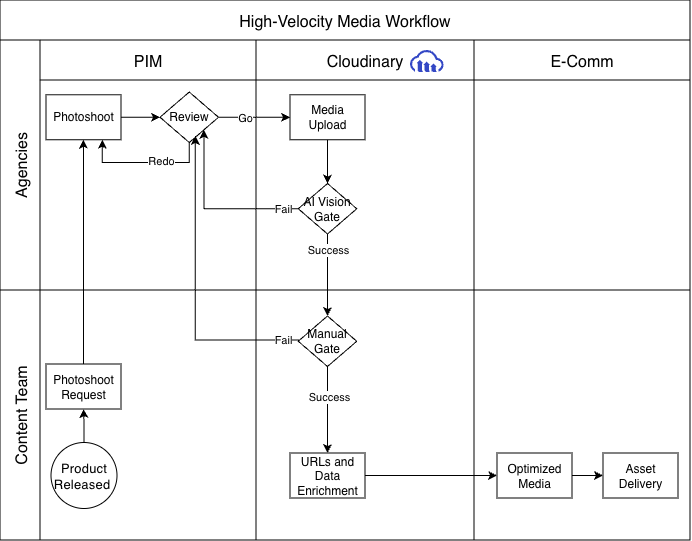
External agencies upload assets through a dedicated Cloudinary upload minisite, enabling controlled onboarding of large media batches. MediaFlows AI Vision automatically moderates and tags these assets, ensuring compliance and quality.
Structured metadata (SMD) automatically populates from embedded metadata (EXIF) or PIM attributes, maintaining alignment between product data and media context.
Once ingested, assets flow into delivery channels such as the eShop or CMS, which use standard Cloudinary integrations. Dynamic overlays or conditional delivery (fn_select) automatically personalizes content based on its stored metadata, so you can adapt a single asset for any product, audience, or campaign.
This blueprint lets teams move from agency photoshoot to personalized e-commerce experiences in record time, combining automated moderation, governed metadata, and fully composable delivery pipelines.
- Single source of truth. Cloudinary anchors asset governance.
- Composable flexibility. Any CMS, PIM, or commerce engine can connect.
- Governance built in. Stage/Prod environments and metadata-first strategies reduce risk.
- Workflow acceleration. From creative capture to storefront, assets flow seamlessly.
Cloudinary is more than a media CDN — it’s the media backbone in modern digital ecosystems, enabling organizations to scale, govern, and automate asset usage across every touchpoint.
Whether you’re designing an e-commerce stack, a brand content pipeline, or a full composable architecture, Cloudinary is a critical piece of the puzzle. Contact us today to learn more.


