Video Maturity Guide

Most Brands Have Video. Few Have a Video Strategy That Scales.

Use this guide to see where your video stands today, learn how leaders run their video operations, and get your Video Maturity Score with clear recommendations on what to do next.

Where Does Your Video Maturity Stand?

Video is an important part of how brands reach their audiences, but it is extremely challenging to scale. The teams doing so have one thing in common: they’ve built the systems that let them move quickly, stay consistent, and reach every channel and market exactly as intended.

Our 2026 customer survey* found that while 92% of respondents plan to expand their video use, they acknowledged a myriad of constraints when it comes to doing so. This guide breaks down where those constraints typically show up and how to work through them by mapping your video operation against four maturity stages so you can see how close your current setup is to that benchmark.

Explore the four stages below, then take the Video Maturity Index assessment to get your Video Maturity Score and personalized recommendations on what to focus on next.

When you’re ready to go deeper, you can talk to a Cloudinary video expert to turn your results into a concrete plan for your team.

“Video is no longer the future of commerce. It’s now the
price of entry.

—Tali Rosman, Managing Director, Video, Cloudinary

01 Video Starter

You’re using video, and it’s working in places. But production costs are high, performance varies, and getting video live across every channel takes more effort than it should. You’re not alone — and there’s a clear path forward.

02 Video Builder

Video plays a role in your customer experience. But mobile performance, workflow handoffs, and the cost of creating variations for every channel are the friction points holding you back.

03 Video Performer

Your video performs well and your team operates efficiently. The next horizon is personalization, scale, and the kind of automation that frees your team for higher-value work.

04 Video Leader

Video is a strategic advantage, not just a channel. It’s woven into how your business operates — every device, every market, every format — and your infrastructure keeps pace without adding headcount.

“Most brands say the biggest barriers to scaling video are cost, limited internal resources, and the overhead of creating variants for every channel.”

—Tali Rosman, Managing Director, Video, Cloudinary

What Video Leaders Do Differently

The difference between good video strategy and great video strategy isn’t one giant leap. It’s five areas where leaders are intentional, and where the right infrastructure makes the difference.

Section 1 of 5
Video leaders start with the customer experience.
Leaders design with the customer journey in mind, and the result is video that builds confidence and drives purchase. The best video experiences don’t call attention to themselves. They load quickly, fit the layout, play at the right moment, and bring products to life in a way static images can’t.
For global fashion retailer Paul Smith, adding video to their product pages drove a 45% increase in video-enabled sales and 31% growth in e-commerce conversion rates.
“When we added video to the product page, we started to see a strong level of engagement conversion with video over straight images.”
—Hannah Bennett, Head of Digital, Paul Smith

Expert Tip
Pick your highest-traffic product page and watch it on mobile without touching it. Does the video play at the moment it would actually help a customer decide? If it autoplays before they’ve read a word, or sits below the fold where nobody scrolls, that’s a placement problem, not a content one.
—Tali Rosman,
Managing Director of Video, Cloudinary

Expert portrait

Video leaders deliver fast, consistent video on every device.
A video that doesn’t load on mobile, crops the wrong part of the frame, or buffers at the wrong moment loses the customer before the content has a chance to work.
Leaders solve this with a video platform that ensures format, quality, and delivery adapt automatically so the experience holds up regardless of device or connection speed.
“Speed is incredibly important, especially for merchandising, which has to work ahead to get content.”
—John Kilpatrick, Director of Technology, Rapha

For Rapha, whose digital channel is its biggest for sales, getting assets out fast enough had become the bottleneck. After moving to a video platform, the brand accelerated video experience creation by 50%.

Expert Tip
Test your highest-traffic product page on a mid-range Android on 4G. If the video stalls, crops incorrectly, or doesn’t load, take note. Your performance baseline should be the device your customers use, not only the one on your desk.
—Simon James,
Senior Director of Product Marketing, Cloudinary

Expert portrait

Video leaders localize once and scale everywhere.
Most teams localize for a fraction of the markets they could reach — not because the demand isn’t there, but because the production overhead makes it feel impossible. The right infrastructure handles subtitles, overlays, and format conversion at the delivery layer, so teams aren’t rebuilding assets for each region.
When localization is set up this way, a single master video can launch in multiple languages and formats at once: product pages, apps, marketplaces, and campaigns all pull from the same source, with captions, overlays, and mobile‑first crops generated automatically.
“The time and skills needed to ready videos for different channels, devices, and markets is the top challenge brands face, cited more often than the cost of creating original content.”
—Cloudinary Video Survey*

Expert Tip
Count the markets you’re localizing video for manually. Now count the markets you actually operate in. If those numbers don’t match, the problem isn’t budget, it’s the process.
—Michaela Mattingly,
Senior Solutions Engineer, Cloudinary

Expert portrait

Video leaders have automated, scalable workflows reducing time-to-market.
Nothing stops a creative team faster than waiting for approval that’s buried in someone’s inbox. Review, feedback, and sign-off should move as fast as the work itself. But the handoff between creative, marketing, and technical teams is where video workflows stall.
Lounge by Zalando cut manual labor across its team and accelerated go-to-market capabilities across every channel by consolidating into a single system.
“Cloudinary reduces the amount of required manual labor and helps us accelerate our go-to-market capabilities.”
—Gaiar Baimuratov, Head of Demand Tech and Product, Lounge by Zalando

Expert Tip
Map your approval flow from upload to publish and count the number of steps. If more than two occur outside a single system — in Teams, Slack, or a shared drive — that’s where your workflow is losing time. Fix the process before you invest in the tooling.
—Mahdi Hamdi,
Sr. Staff Technical CSM, Cloudinary

Expert portrait

Video leaders leverage AI wisely to reduce costs and drive efficiencies.
Most teams are still doing production work manually that automation handles in seconds: tagging, cropping, transcription, and format conversion. Video leaders automate it, and the time and cost savings follow.
Paul Smith, for example, saw a 40% reduction in asset management costs after automating its video workflows.
83% of video teams will use AI in their workflows within the year.

Only 37% use it today — but metadata generation (tagging, titling, and describing) is the leading use case for teams adopting it next, as they shift from manual production to automation.
—Cloudinary Video Survey*

Expert Tip
Pick one video from your library and check its metadata. Does it have accurate tags, a title, chapter points, and a description? If not, that’s what’s missing when search engines and, increasingly, AI shopping agents, try to surface your products. It’s the easiest gap to close, and it compounds.
—Timothy Tran,
Staff Solutions Engineer, Cloudinary

Expert portrait

Your Video Maturity, Scored

Three minutes to see where your video operation is strong, where it is slowing growth, and what to fix next.

GET YOUR SCORE

How to Become a Video Leader

You don’t have to solve everything at once. After you take our Video Maturity Index Assessment, it will classify you as a Video Starter, Builder, Leader, or Hero and surface a few strengths and focus areas. This section turns those stages into practical next moves, so you can start improving your video operation from wherever you are today.

If You’re a Video Starter

Start with your worst-performing touchpoint, not your best.

Find the customer journey where video performance is slowest, lowest quality, or missing entirely, and make that your starting point. The biggest gains come from fixing what’s actively hurting the experience, not from optimizing what’s already working.

For Hydrow, that meant finding a single source of truth for all its video assets and letting delivery handle the rest.

“For visual asset management, if you need to optimize front-end performance, Cloudinary is the best way to fire and forget.”

—Reuben Kabel, SVP of Engineering, Hydrow

If You’re a Video Builder

Map your video workflow before you automate it.

Automation makes your video workflow faster, which means you reduce the time to publish and increase revenue sooner. Map your video workflow from upload to publish before you invest in tooling. If more than a couple of steps happen in email, chat, or shared drives, that’s where you’re losing time.

Pick one step that happens on every video — approvals, crops, variants — and move it into a single system. Once that’s predictable, automate the repeatable work so your team isn’t stuck doing the same tasks over and over.

If You’re a Video Performer

Make your best video journeys boringly reliable.

You’ve already proven video works. Key pages and campaigns perform reliably, and your team can ship assets quickly. The next move is to standardize what happens after a video is approved.

Pick the journeys where video clearly engages customers and lock in a simple rule set for going live: default aspect ratio, player placement and start behavior, which devices you test on, and when subtitles or translations are required.

Once those standards are in place, it’s easier to see which changes improve performance. This is the bridge between “we have good video” and “we have a high-quality video operation,” without jumping straight to global reuse and personalization.

If You’re a Video Leader

Treat every video like a reusable asset, not a one-off.

At this stage, the question isn’t, “Can we ship video?” It’s, “How far can each asset go?” This is where personalization, localization, and automation start to compound.

Treat metadata as a first step, not an afterthought. Titles, tags, chapters, and descriptions make your video easier to find — for search engines today and for new discovery surfaces tomorrow.

Not sure where you land?

If you’re not sure which stage you’re at, start with our Video Maturity Index Assessment. You’ll get a score, a classification, and a short set of “you’re doing this well” and “think about this next” recommendations.

Are You a Video Starter or Video Leader?
Find Out Now.

Your Video Infrastructure, Handled by Cloudinary

Cloudinary Video is the video platform behind some of the world’s most recognized brands. It handles the entire video workflow and delivery infrastructure so your team can create, manage, and deliver video experiences that perform at scale.

Deliver videos that perform everywhere.
Progressive auto-play videos, adaptive bitrate streaming, automatic format conversion, and 
 optimized delivery across every device and connection speed. Your customers get fast, consistent video wherever they are.

Set up workflows once. Let them run.
Tagging, cropping, transcoding, format conversion, video metadata generation — automated from upload to publish. Your team gets its time back.

Optimized, accessible, and ready to be found.
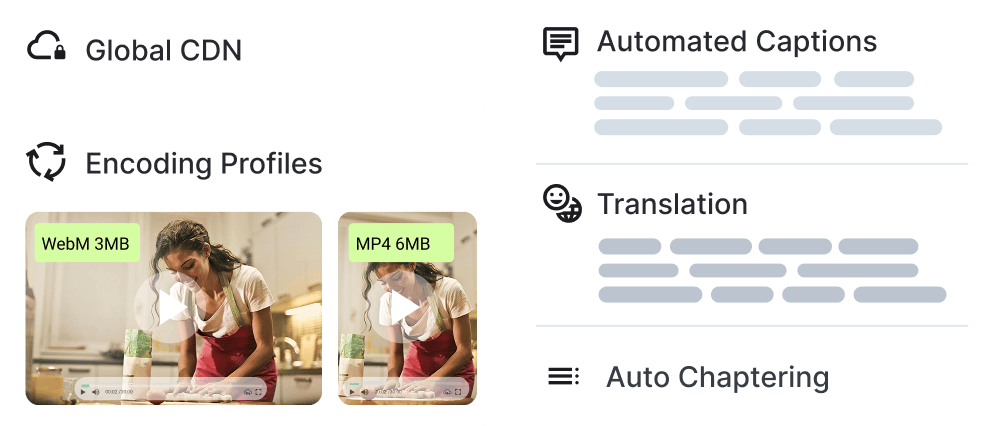
Auto transcription, captions, smart cropping, AI previews, and translations — your video is optimized, accessible, and discoverable before it goes live.

“In all honesty, I don’t know a world without Cloudinary or its DAM solution now.”
—Hannah Bennett, Head of Digital, Paul Smith

See Cloudinary Video in Action →


*Source: Cloudinary 2026 Customer Video Survey, n=59. Internal survey of existing customers; results reported in aggregate.