
Before we choose between Magento or Shopify, we need to understand the different approaches that they take. Magento (Open Source) is customizable down to the smallest details, and Shopify has a user-friendly interface that is perfect for no-code users.
The choice we make will determine our workflow when adding new components for our store. We’ll also discover how Cloudinary can take the hassle out of managing our media, no matter which online shopping platform we decide on.
Key Takeaways
- Shopify gives us simplicity and speed, which is perfect for getting started
- Magento provides deep customization for complex large-scale deployments
- Costs vary between hosted and self-managed scenarios
- Cloudinary helps site owners optimize images on both platforms at scale
In this article:
- Picking the Best Online Shop Builder
- What Makes Magento or Shopify Different?
- Main Features: Comparing Magento or Shopify
- Cost Comparison: Is Magento or Shopify Cheaper?
- Optimizing Product Images With Cloudinary
Picking the Best Online Shop Builder
Setting up an e-commerce store is a big step; the decisions that we make in the beginning will be with us for years. The platform that we decide on will shape how we manage products and process orders, as well as how our business scales online. We must try to think of the bigger picture with a longer time horizon before we decide.
What Makes Magento or Shopify Different?
Both Magento or Shopify are excellent e-commerce options, but they follow different philosophies. Shopify is a fully hosted solution that takes care of the technical details for us. It’s a very user-friendly experience where we sign up, pick a theme, add our products, and we’re up and running in a few hours.
Magento takes the opposite approach. It’s free and open-source software that you install and manage yourself. You are in control of everything, which means you are also responsible for managing everything. That includes hosting, security, and future updates.
Note: Adobe Commerce is a separate paid enterprise version, but we’re focusing on the free Magento Open Source edition.
The hosted versus self-hosted models make a big difference to how you manage your e-commerce site. With Shopify, you can think of it as renting space in someone else’s ecosystem. With Magento, you’re building your own store from the ground up.
The Benefits and Drawbacks of Shopify
Shopify is a great option if we want to focus only on selling and not have to worry about server maintenance and managing the back end of our site. Anyone can launch a basic site quickly, with professional stores taking a few weeks to set up, customize and launch.
Their integrated app store gives users thousands of plugins to add extra functionality to their eCommerce site with ease.
The drawback is that some of these apps cost money. Shopify provides a lot of apps that will add extra features to your site, but some third party apps will operate on a one off purchase, a monthly subscription, and some operate on a usage model.
If there are very specific features that we need, then we are limited to what we can find in the Shopify ecosystem–which can be a problem if we can’t find the app that we are looking for.
The Pros and Cons of Using Magento
Magento hands you full control over everything in your store. If you want a customized checkout, you can build it. Need a custom pricing engine? No problem; you can build it yourself. If you have the developer resources, then you can customize just about everything to suit your business.
Businesses of all sizes use Magento because it handles complexity without breaking a sweat. You can set up multiple storefronts, advanced inventory, custom integrations–Magento was built to give you control and flexibility. This complexity can also have its downsides, depending what dev resources you can commit.
Main Features: Comparing Magento or Shopify
Both platforms cover the basics. Product management, order processing, and payment gateways can all be configured to run with our store. The major difference is in how much control we get over our systems.
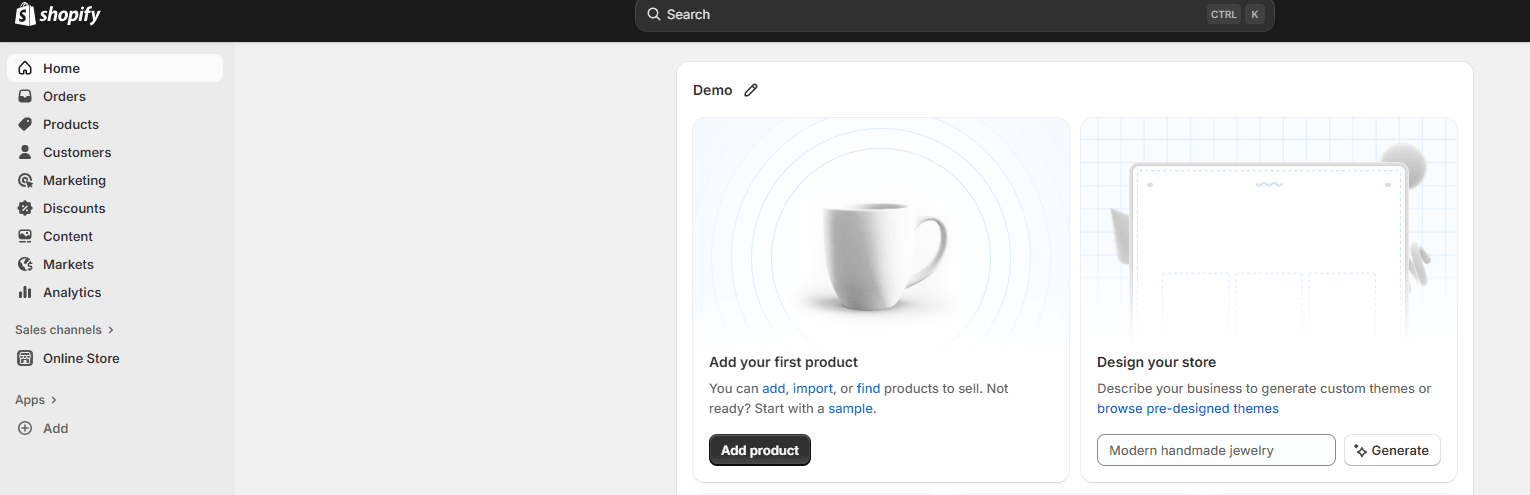
Shopify has a clean interface that is easy to use and navigate
Shopify is an excellent out-of-the-box solution. It has a built-in blogging platform, analytics dashboards, and mobile tools that work great for most businesses. It’s an excellent starting point for most people, and it has enough features to satisfy our most common needs. The drawback is that some of the additional features will cost money to integrate into our store.
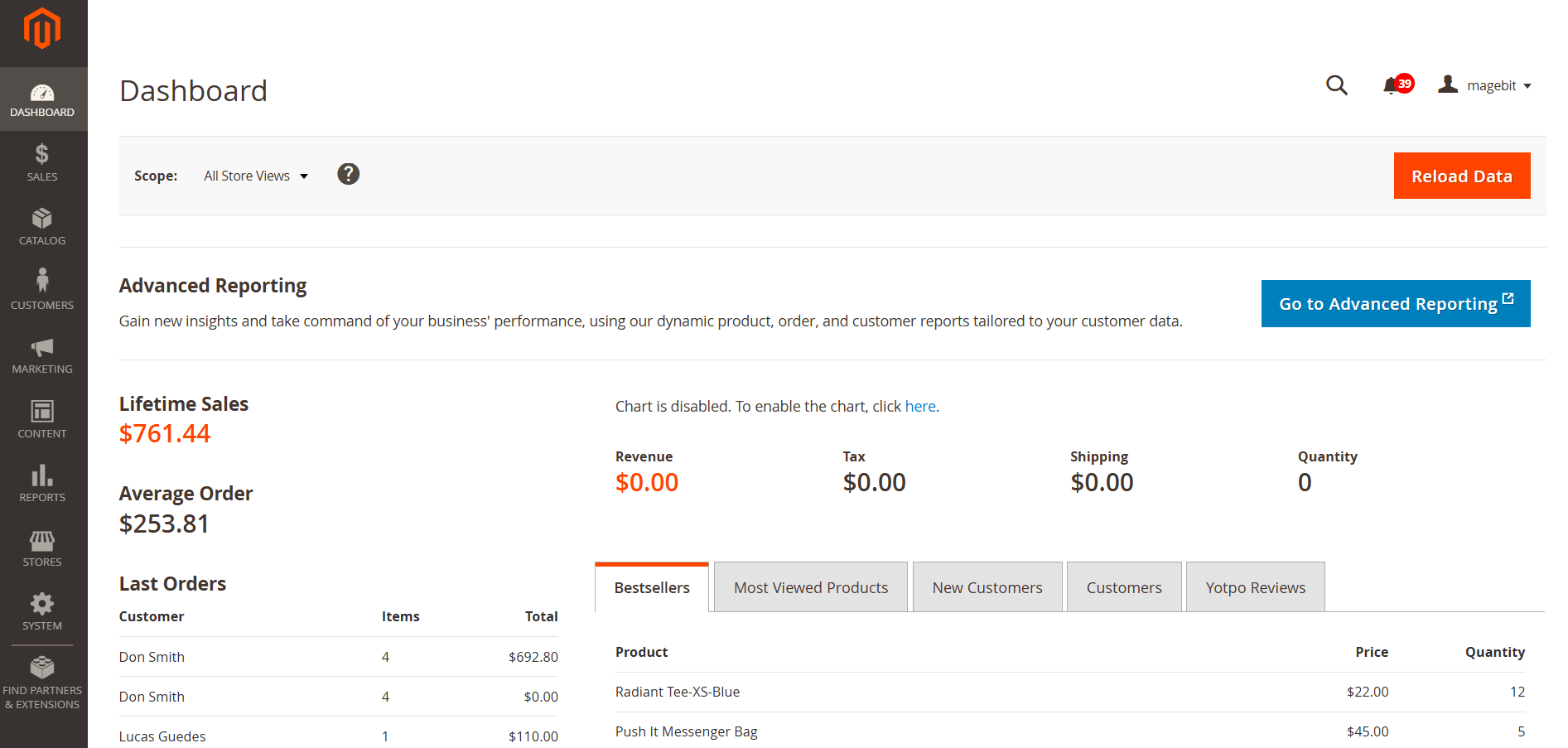
Magento has tons of customization options available in its Admin Panel
Magento gives you a finely tuned experience that will let us customize anything we want in our store. You can create custom tax rules for international customers, set up a multi-warehouse inventory with the Multi-Source Inventory framework, and just about anything else that you need to make the store work for your business.
Understanding Customer Service and Ease-of-use
Shopify’s support team is available 24/7 through chat and email on all plans, with telephone support available through higher tiers as well. Users find Shopify’s interface really easy to use because of its focus on simplicity.
Magento has a steep learning curve. Its admin panel gives us access to powerful features, but if we are new to eCommerce, then it can feel a little overwhelming in the beginning. Since this is the free version, there is no official Adobe support. You’ll have to rely on other resources like forums and tutorials, or pay for consultants to help us if we hit a major technical snag.
Cost Comparison: Is Magento or Shopify Cheaper?
Both platforms have costs that we will need to factor into our monthly expenses. Shopify has pricing that is easy to understand, and going with an annual plan works out cheaper than paying every month. Pricing starts at around $39 USD on the Basic Plan with transaction fees of 2.9% + 30¢ USD / 2.6% + 10¢ USD / 2%.
Magento’s pricing, while free to use by default, is a little trickier to nail down exactly because of how customizable it is. Hosting costs vary by provider, and it’ll also depend on the resources you need to spin up to host all of your components. Hosting can cost anywhere from $100 to $1000 a month, depending on volumes and traffic.
These additional factors will drive up the monthly cost of running and maintaining our Magento store, so while the app itself is free, there are a lot of extra services that you’ll need to pay for to keep it up and running every month.
Small to medium-sized stores usually spend less with Shopify initially, but as they need more features or find their transaction volumes increasing, their pricing will climb. Stores that need advanced features and want to avoid percentage-based transaction fees will find that Magento is cheaper over a longer time period.
Optimizing Product Images With Cloudinary
Product images make or break an e-commerce site. High quality images and videos help to drive conversions. If our products don’t look great on our site, our chances of getting sales are reduced dramatically.
Then, we need to think about scale. If you’re managing hundreds, or even thousands of images, manually managing them can be an absolute nightmare. Each image needs its own custom resolution for different devices so that it’s responsive and displays properly, and if you’re doing this manually, then you’re going to spend a lot of time setting up and maintaining them.
Cloudinary integrates with both Magento or Shopify to automate image management for you. It handles automatic image resizing, format conversions, and image compression with no need to manually go over every one. Just upload a high-quality image, and Cloudinary will generate images for every device.
Shopify users just need to install Cloudinary from the app store. Magento users can plug into the Cloudinary Extension giving developers full control over how images are processed and delivered to our store.
