
What Is Clipping Path?
Clipping path, in its simplest form, is a digital image editing technique that involves the process of outlining or “clipping” a subject or object from its background using a vector path. It’s commonly used by photographers, graphic designers, and e-commerce businesses to showcase their products and enhance visual appeal without any distractions.
Understanding the foundations of the clipping path enables users to isolate subjects from the background, allowing them to be separated and re-used elsewhere. This image editing method can generate crisp, polished images that emphasize vital product features or design aspects.

How Does Clipping Path Work?
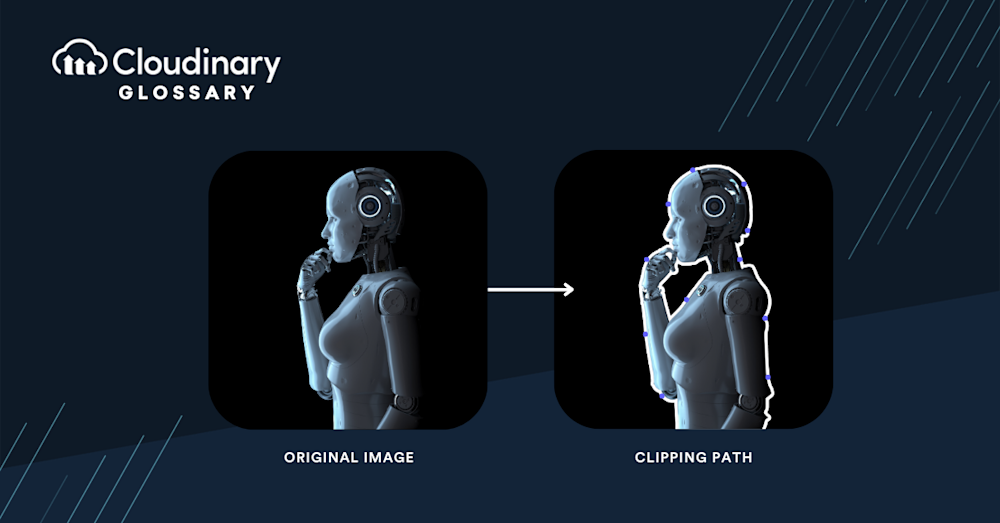
A clipping path is a vector outline that isolates a specific part of an image. It defines which areas remain visible and which areas are hidden. Designers and developers use clipping paths to remove backgrounds, highlight subjects, or prepare images for further processing.
The process begins by drawing a path around the object you want to keep. This path is created using vector points connected by lines and curves. Once the outline is complete, the area inside the path stays visible while everything outside the path becomes transparent or hidden.
Because clipping paths rely on vector data, the edges remain sharp and precise. This makes them well suited for images with clear boundaries such as products, devices, or objects with defined shapes. The result is a clean cutout that can be placed on different backgrounds or layered into new compositions.
Clipping paths also support automated image workflows. After a path is created, it can be reused across different transformations such as resizing, cropping, or format conversion. This allows images to be processed consistently across web applications and content pipelines.
For developers building media-heavy applications, clipping paths help prepare assets for flexible delivery. They ensure that images remain clean, focused, and ready for transformation within modern media management systems.
How Clipping Paths Work in 3D Graphics
In 3D graphics, clipping paths help control which parts of a rendered scene remain visible. A path or boundary defines the region that the renderer keeps while hiding geometry or pixels outside that area. This technique supports precise compositing and scene preparation before final output.
The process usually starts by defining a vector shape or mask within the 3D software. That shape acts as a boundary during rendering or post processing. Objects or pixels inside the path remain visible, while anything outside the defined region is excluded from the final image.
Clipping paths often appear in workflows that prepare renders for compositing, background replacement, or layered visual effects. For developers managing media pipelines, these paths help produce clean assets that can move through transformation, optimization, and delivery stages without extra manual editing.
How To Make a Clipping Path
- Open the image you want to edit in your preferred design or editing software.
- Select the path or pen tool. This tool lets you draw a precise vector outline around the subject.
- Zoom in so you can clearly see the edges of the object–even up to 200-300%.
- Click to place anchor points along the edge of the subject. Use more points around detailed areas and fewer points on straight edges.
- Drag when needed to create curved segments. This helps the path follow rounded shapes more naturally.
- Continue tracing until you return to your starting point and close the path.
- Review the outline carefully. Adjust anchor points, curves, and line segments so the path fits the object cleanly.
- Save the path in the file. Many tools let you name and store it for later use.
- Convert the saved path into a clipping path or mask using the software’s path settings.
- Preview the result to confirm that the subject stays visible and the background is hidden.
- Export the image in a format that supports the result you need, such as a format with transparency if the background should remain removed.
- Test the final asset in your workflow to make sure the edges look clean on different backgrounds and at different sizes.
Why Is Clipping Path Important?
Clipping paths play a key role in preparing images for modern digital workflows, as they allow you to isolate a subject from its background with precise edges, which makes it easier to reuse and transform visual assets across different platforms.
In ecommerce, clipping paths help product teams create clean product photos that can be placed on consistent backgrounds across catalogs, ads, and storefronts. In marketing and media production, designers use clipping paths to prepare layered assets for campaigns, social graphics, and promotional materials. Publishing teams also rely on clipping paths to position images within layouts without distracting backgrounds.
For developers managing media pipelines, clipping paths support scalable image processing. Once an image subject is isolated, the asset can move through automated transformations such as cropping, resizing, and format optimization. This helps ensure consistent presentation across websites, mobile apps, and content delivery systems while reducing the need for repeated manual editing.
Final Thoughts
Clipping paths are a foundational technique for isolating subjects and preparing images for flexible use across digital platforms. By defining a precise vector boundary, they allow you to control what remains visible in an image and remove unwanted background elements. This simple concept supports a wide range of workflows, from manual design work to automated media pipelines.
Understanding how clipping paths work helps you produce cleaner assets that are easier to reuse, transform, and deliver at scale. Whether you are preparing product photos, compositing marketing visuals, or generating layered graphics, clipping paths ensure consistent and professional results.
Check Out Our Tools That You May Find Useful:


